Overview
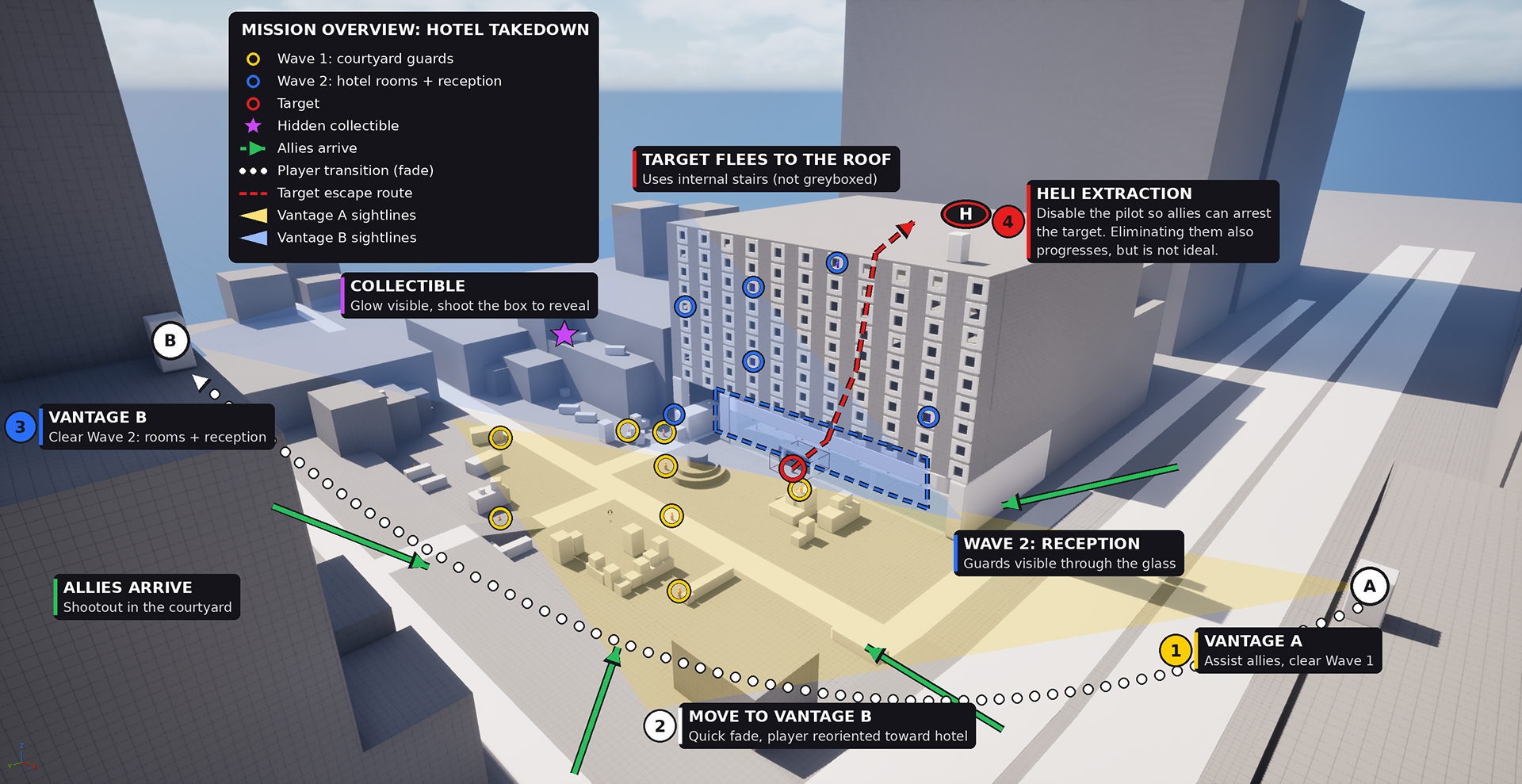
Hotel Takedown is a two-vantage sniper mission I greyboxed in Unreal Engine 5, loosely inspired by the first level of Silent Scope and designed with standalone VR in mind.
The Mission
The mission plays out in four beats across two rooftop vantage points.
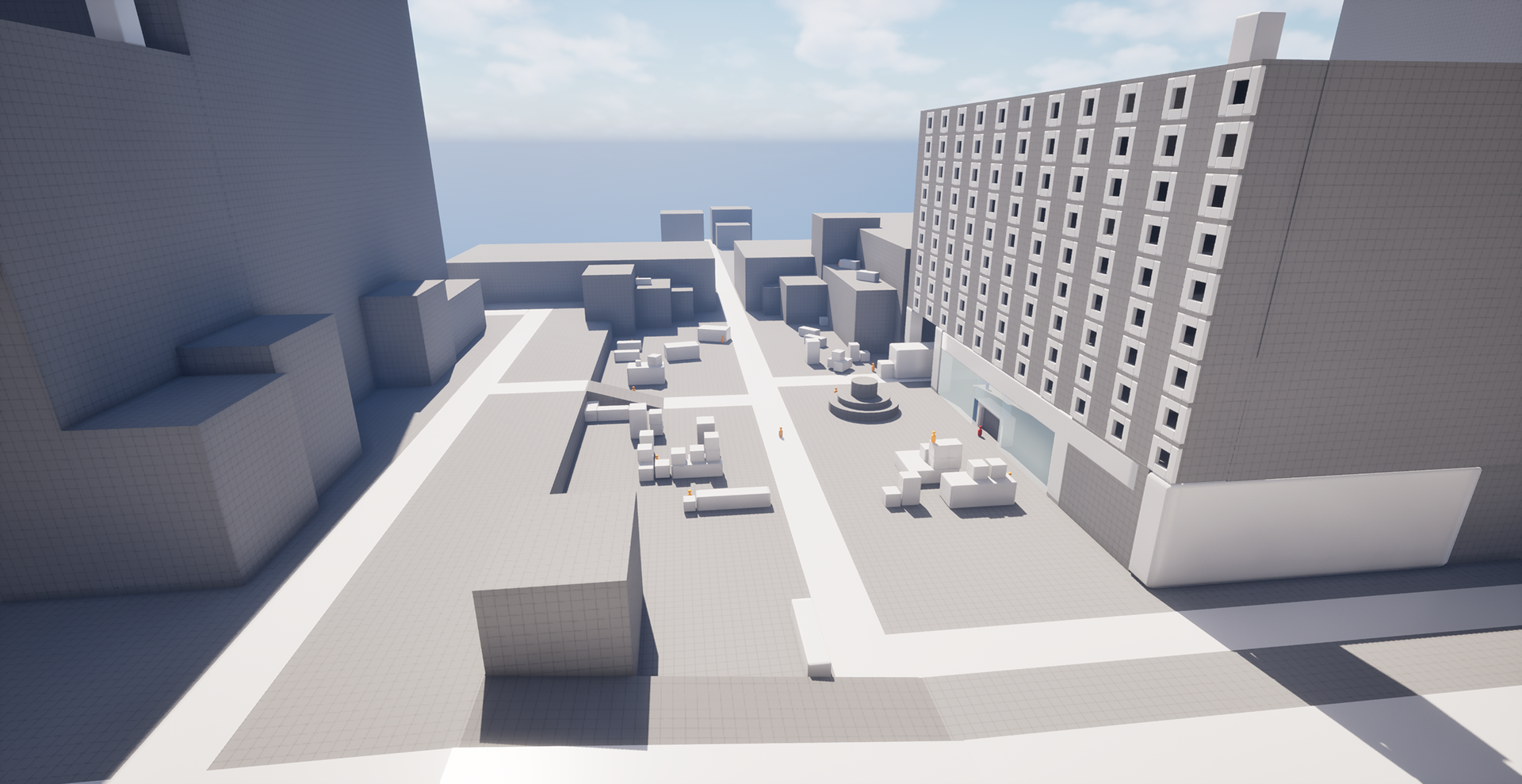
Vantage A: support the shootout. The player overlooks a courtyard in front of the hotel as allies arrive from the surrounding streets and engage the target's guards. The player picks off guards sheltering behind vehicles, crates and a fountain plinth.
Move to Vantage B: Once the courtyard is clear, a quick fade carries the player to a second rooftop roughly 135° around the space. They're reoriented so the hotel lands directly in front of them.
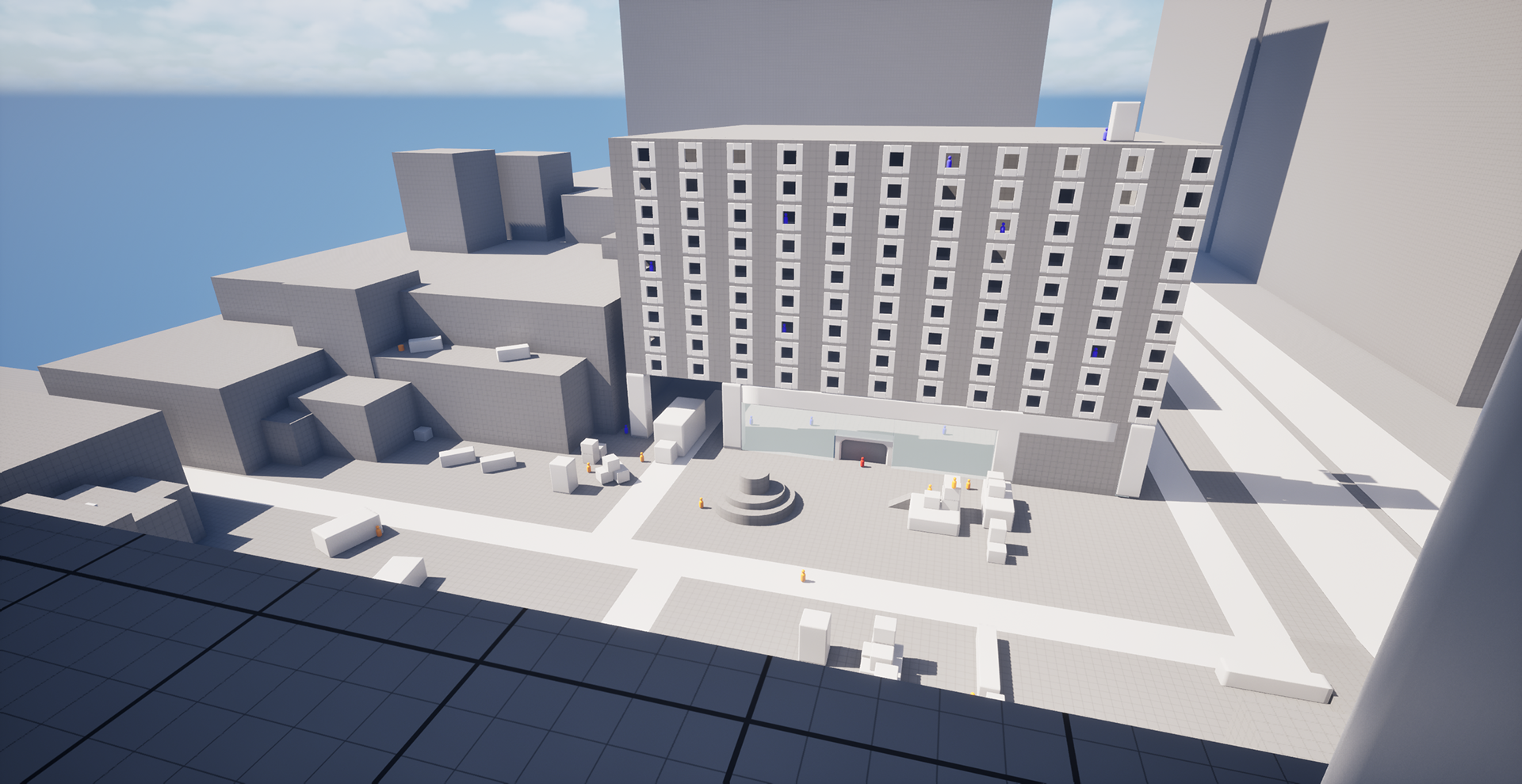
Vantage B: clear the hotel. The fight moves inside. Guards are posted in hotel rooms across several floors and behind the reception glass, so the player scans the facade floor by floor.
Heli extraction: The target flees up the internal stairs to the roof as a helicopter arrives. Disabling the pilot lets allies reach the roof and make the arrest. Eliminating the target also lets the player progress, but it's the lesser outcome.
View from Vantage A

Beat Sheet
Design decisions
A second angle that changes the space: From Vantage A, the hotel facade sits at a steep angle and its windows barely read, so the first beat stays focused on the courtyard. From Vantage B the facade faces the player head on, and cover that protected guards from the first angle no longer hides them.
Targets that read at distance: Window openings are 2 × 2 m so occupied rooms are readable from across the courtyard. The window frames use chamfered meshes that catch the light, and guards are spread across different floors so the player's eye travels vertically as well as across.
Cover with a reason to be there: Cover is grouped around things that belong outside a hotel, like vehicles, deliveries and a fountain plinth, rather than scattered evenly. The surrounding streets give allies a believable way into the fight.
Comfortable movement in VR: The move between vantages is a short fade rather than a moving camera. Reorienting the player during the fade means they never have to physically turn around to find the action.
A reason to look twice: A collectible is hidden behind a box on a rooftop near the hotel. Only its glow is visible, so players have to notice it and shoot the box to reveal it.
View from Vantage B
Building it in Unreal
The level is blocked out with Unreal's level prototyping meshes, snapped to a 1 m grid and sized to real-world proportions so vehicles, doors and storeys read at the right scale.
Modular hotel facade. I built a single bay (4 m wide, one storey, a 2 × 2 m window and a shallow room behind it) and saved it as a Level Instance. Repeating it across the facade meant one edit updated every bay, and I broke out individual bays for the reception and main entrance, including the loading dock.
Mesh choice for readability: Plain cubes form the large masses like slabs, roofs and room shells. Chamfered cubes frame the windows so each opening stands out.
Lit and unlit rooms: I made two versions of the room Level Instance: one whose interior casts shadows and one that doesn't. Sunlight fills the shadow-free rooms so they read as lights on, while the shadowed rooms stay dark and read as empty, all without placing a single light.
Reception glass: A simple translucent material lets the player see guards in the lobby from Vantage B.
Only what the player sees: Only the player-facing facade is built in detail. The rooms are about 3 m deep, and the back of the hotel is a plain mass.